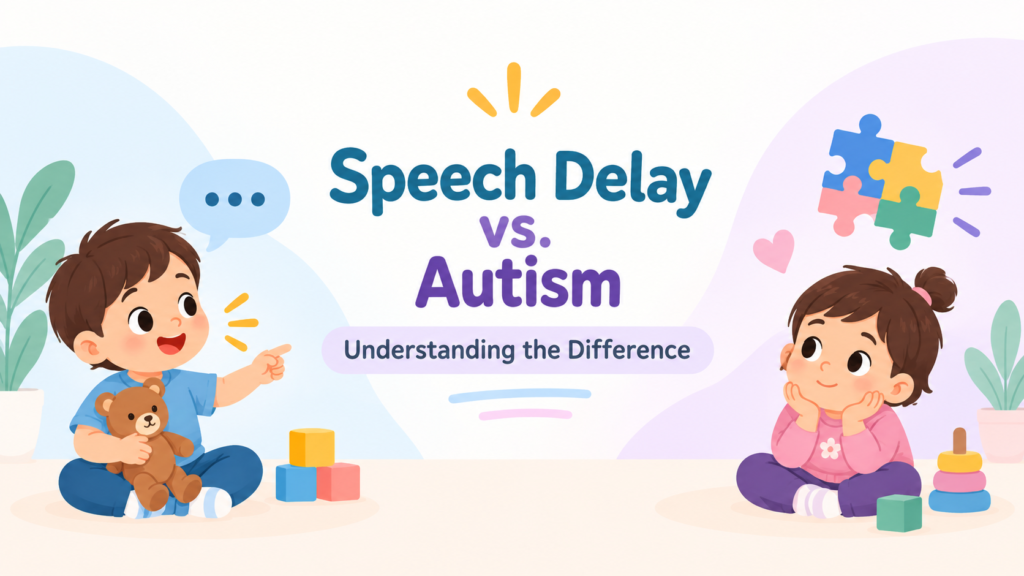
Speech Delay vs. Autism: Understanding the Difference
Understanding how your child communicates can help you identify when additional support or a professional assessment may be helpful.
Many parents become concerned when their child is slower to start talking than other children. One of the most common questions they ask is whether their child has a speech delay or Autism Spectrum Disorder (ASD).
While both may involve delayed speech, the broader pattern of communication, interaction and development can look quite different.
How Speech Delay and Autism May Differ
Speech delay primarily affects spoken language development, while autism can involve broader differences in social communication and behaviour.
Speech Delay
A child with a speech delay may have difficulty producing spoken language, but often continues to communicate socially in other ways.
They may use:
✓ Eye contact
✓ Pointing and gestures
✓ Facial expressions
✓ Social interaction
✓ Non-verbal communication
Autism Spectrum Disorder
Autism may involve delayed language together with differences across several areas of communication, behaviour and interaction.
Differences may include:
✓ Social communication
✓ Joint attention
✓ Repetitive behaviours
✓ Restricted interests
✓ Sensory responses
One sign alone does not provide a diagnosis
Children develop differently. A professional assessment considers the child's overall communication, interaction, language and developmental profile rather than relying on a single behaviour.
Why a Comprehensive Evaluation Matters
A comprehensive evaluation by a speech-language pathologist helps identify a child's communication strengths and challenges and determine the most appropriate intervention.
Instead of focusing only on whether a child is talking, clinicians examine how the child understands language, expresses needs, interacts with others and uses verbal and non-verbal communication.
An evaluation may look at:
How Therapy Goals May Differ
Therapy should always be personalized according to each child's strengths, communication needs and developmental goals.
For Speech Delay
• Building vocabulary
• Speech sound development
• Combining words
• Sentence formation
For Autism
• Functional communication
• Social interaction
• Understanding and expressing language
• Alternative communication when needed
What Can Parents Do?
Observe Communication
Notice how your child communicates using eye contact, gestures, facial expressions and sounds.
Seek Assessment
Choose a comprehensive professional assessment rather than relying on one particular sign.
Keep Playing
Continue joyful, interactive play and everyday communication while seeking professional guidance.
Early Identification Can Make a Difference
Early identification helps children receive the right support as soon as possible. The goal is not to compare children, but to understand each child's individual communication profile and support their development.
How SpeechSparkle Can Help
At SpeechSparkle, our clinicians provide detailed speech and language assessments to identify communication strengths and challenges, followed by personalized therapy plans that support every child's unique developmental journey.
Unsure Whether Your Child Has a Speech Delay or Autism?
Schedule a comprehensive online speech and language assessment with SpeechSparkle and get professional guidance tailored to your child's communication needs.
Schedule an Online Assessment →